Key Takeaways
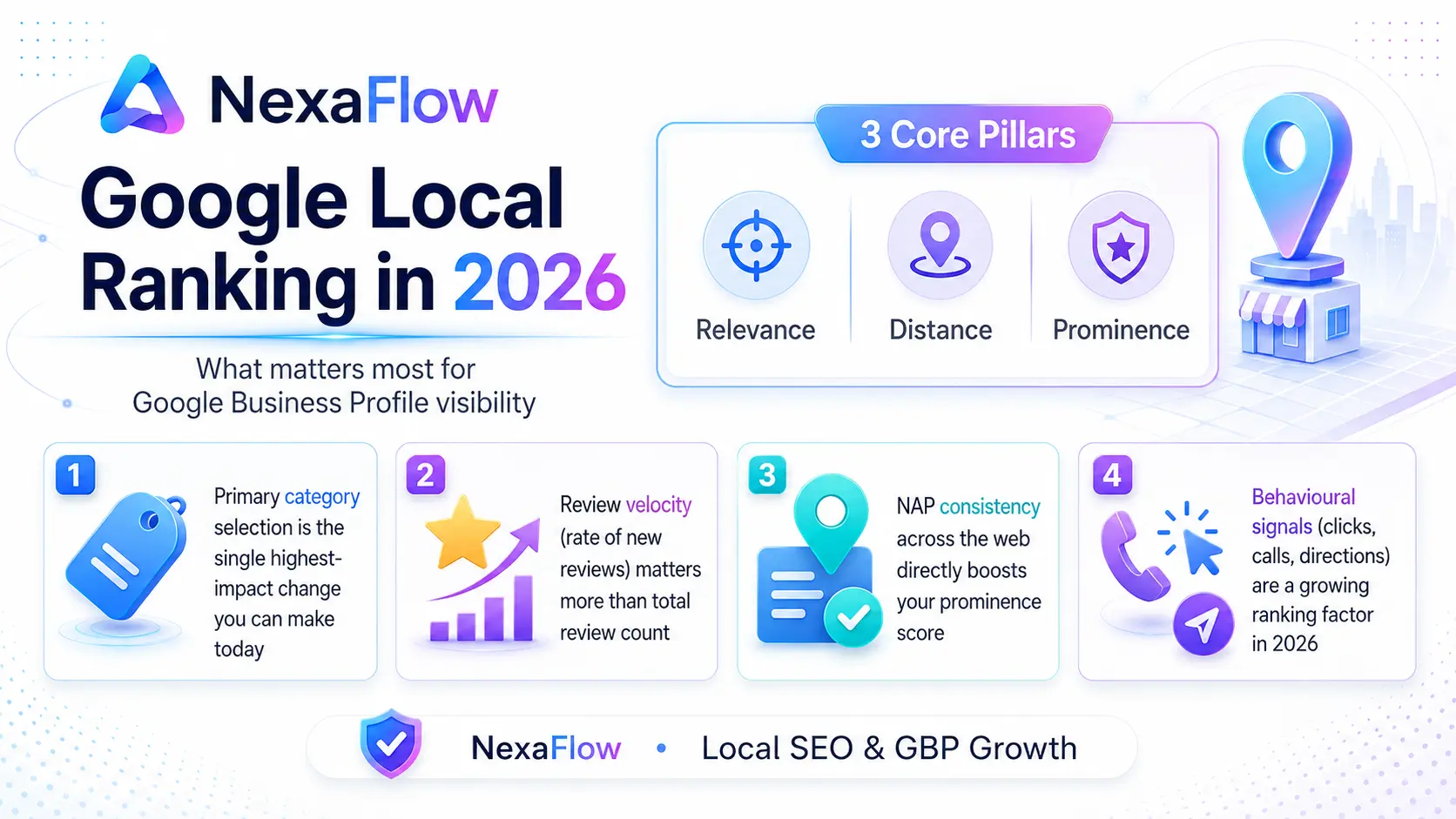
- Google's local algorithm uses three pillars: Relevance, Distance, and Prominence
- Primary category selection is the single highest-impact change you can make today
- Review velocity (rate of new reviews) matters more than total review count
- NAP consistency across the web directly boosts your prominence score
- Behavioural signals (clicks, calls, directions) are a growing ranking factor in 2026
How Google Ranks Local Businesses
When someone searches "dentist near me" in Kanpur, Google doesn't show a random selection. It runs a complex local ranking algorithm that weighs dozens of signals across three core pillars — and understanding these pillars is the foundation of any successful GBP strategy.
Google's own documentation confirms the three pillars: Relevance (how well your profile matches the search), Distance (proximity to the searcher), and Prominence (how well-known and trusted your business is). But within each pillar, there are multiple sub-signals — and knowing which ones carry the most weight is what separates a top-3 ranking from page 2 obscurity.
Why This Matters for Indian Clinics
In most Tier-2 Indian cities like Kanpur and Lucknow, the competition in Google Maps is still relatively low. This means even moderate optimisation — if done correctly — can push a clinic into the 3-Pack within 60–90 days. The window of opportunity is open now.
Relevance Factors: Make Google Understand Your Business
Relevance signals tell Google what your business does and who it serves. These are entirely within your control and should be the first thing you optimise.
1. Primary Business Category
Your primary GBP category is the single most powerful relevance signal. It directly determines which search queries your profile is eligible to rank for. A dental clinic that selects "Health Consultant" as its primary category will never rank for "dentist near me" — no matter how many reviews it has.
Always choose the most specific category that accurately describes your core service. Avoid generic categories like "Medical Clinic" when a specific one like "Dental Clinic" or "Orthodontist" exists.
2. Business Description Keywords
Your 750-character business description is crawled by Google for keyword relevance. Naturally incorporate your primary service keywords, location, and specialities. Avoid keyword stuffing — write for humans first, search engines second. A description that reads well and includes terms like "dental implants in Kanpur" or "homeopathic doctor in Lucknow" will outperform a stuffed list of keywords.
3. Services & Attributes Completeness
Every service you add to your GBP creates an additional keyword opportunity. Each attribute (wheelchair accessible, accepts insurance, online booking) adds relevance for filter-based searches. Most clinics leave these sections empty — which is a significant missed opportunity.
Pro Tip
Study your top 3 competitors in Google Maps. Note every category, service, and attribute they've filled in that you haven't. Matching or exceeding their completeness is the fastest relevance win available.
Distance Factors: What You Can (and Can't) Control
Distance is the factor you have the least direct control over — Google calculates the physical distance between your registered address and the searcher's location (or the location specified in the search).
However, you can influence distance-related ranking indirectly:
- Service Area Settings: If you serve customers at their location (e.g., a home-visit doctor), set your service area to include all the localities you cover. Google will show your profile for searches in those areas.
- Location Keywords on Website: Having dedicated location pages (e.g., "Dental Clinic in Civil Lines, Kanpur") signals your geographic relevance to Google and strengthens your GBP indirectly.
- Multiple Locations: If you genuinely have a second clinic location, register it as a separate GBP listing. This doubles your Maps coverage.
Warning: Never Use a Fake Address
Some businesses try to create GBP listings with fake addresses in areas they don't serve. Google actively detects and removes these listings — and the penalty can include suspension of your real listing. Never risk your primary listing this way.
Prominence Factors: Build Trust at Scale
Prominence is the most complex and competitive ranking pillar. It reflects how well-known and trusted your business is — both online and offline. Google draws from multiple sources to calculate prominence.
4. Review Signals (Quantity, Rating & Velocity)
Google reviews are the most visible prominence signal. Three sub-factors matter:
- Review Count: More reviews generally means better ranking, but quality matters more than pure quantity.
- Average Rating: A 4.5+ rating is the threshold for competitive ranking in most Indian cities. Below 4.0 significantly hurts your chances.
- Review Velocity: Getting reviews consistently (even 2–3 per week) signals active engagement to Google. A profile with 200 old reviews and no recent ones may rank below a profile with 40 recent reviews.
5. Website Authority & Local SEO Signals
Your GBP doesn't exist in isolation — it's strongly connected to your website. A well-optimised website with strong domain authority, local keywords, and consistent NAP (Name, Address, Phone) information significantly boosts GBP prominence. Google cross-references your website to validate and strengthen your local profile.
6. Citations & NAP Consistency
Every time your business name, address, and phone number appears on the web (directories, social profiles, news articles), it counts as a citation. Inconsistent NAP across platforms — even a minor discrepancy like "Rd" vs "Road" — can confuse Google's algorithms and suppress your ranking. Audit your citations annually and fix any inconsistencies.
Behavioural Signals: The Rising Ranking Factor
In 2026, behavioural signals have become increasingly important in Google's local algorithm. These are actions real users take on your GBP listing:
- Click-Through Rate (CTR): How often users click your listing when it appears in search results. A compelling business name, high rating, and professional photos improve CTR.
- Direction Requests: Users asking Google Maps for directions to your business signals real-world popularity.
- Phone Calls: Calls made directly from your GBP listing are tracked and signal user intent.
- Website Clicks: Users clicking through to your website from GBP shows the listing is driving value.
- Photo Views: Profiles with regularly updated, high-quality photos receive significantly more views and engagement.
Related: The Complete GBP Optimization Guide (2026) — Learn how to optimise every element of your GBP profile.
All 15 GBP Ranking Factors at a Glance
| # | Ranking Factor | Pillar | Impact | Your Control |
|---|---|---|---|---|
| 1 | Primary GBP Category | Relevance | Very High | Full |
| 2 | Secondary Categories | Relevance | High | Full |
| 3 | Business Description Keywords | Relevance | Medium | Full |
| 4 | Services Listed | Relevance | High | Full |
| 5 | Profile Completeness | Relevance | High | Full |
| 6 | Physical Distance to Searcher | Distance | Very High | None |
| 7 | Service Area Settings | Distance | Medium | Full |
| 8 | Review Count | Prominence | Very High | Indirect |
| 9 | Average Star Rating | Prominence | Very High | Indirect |
| 10 | Review Velocity | Prominence | High | Indirect |
| 11 | Review Response Rate | Prominence | Medium | Full |
| 12 | Website Domain Authority | Prominence | High | Indirect |
| 13 | NAP Citation Consistency | Prominence | Medium | Full |
| 14 | GBP Post Activity | Prominence | Medium | Full |
| 15 | Behavioural Signals (CTR, Calls) | Prominence | High | Indirect |
Know Your Ranking Gaps — Fix Them Fast
Get a free audit that identifies exactly which ranking factors are holding your GBP back — with a prioritised fix list specific to your business.
Free. No commitment. Delivered within 24 hours.
Frequently Asked Questions
Profile completeness combined with review quantity and quality are consistently the strongest ranking signals. A complete, verified GBP with 50+ reviews and a 4.5+ rating significantly outperforms incomplete profiles in the Local Pack.
Yes. Your website's domain authority, on-page local SEO signals (NAP consistency, local keywords, location pages), and overall trustworthiness all influence GBP prominence — one of the three main ranking pillars Google uses.
Google's local search algorithm evolves continuously, though major updates happen a few times per year. Core factors like relevance, distance, and prominence have remained stable, but their relative weighting shifts. Staying consistent with best practices is more important than chasing each update.